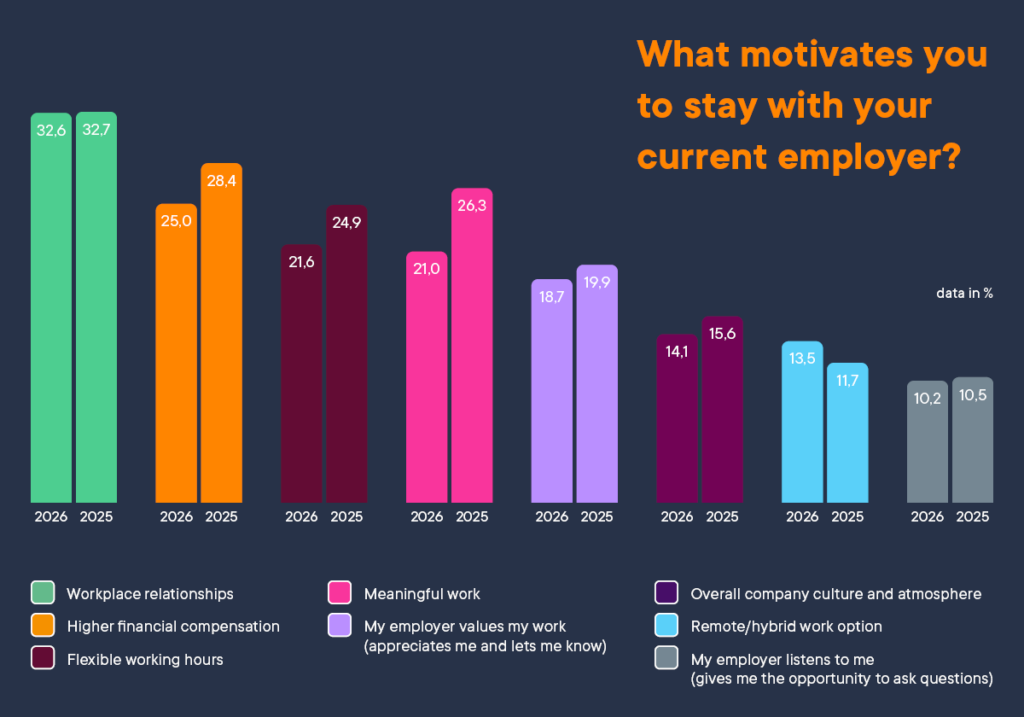
Fifteen percent of people plan to change jobs within the next six months, fewer than last year. However, this does not necessarily mean greater stability. Today, workplace relationships often play a bigger role in employee retention than salary itself. This is one of the findings from the Employee Barometer conducted by Up Benefity.

Relationships carry more weight than paychecks
The decision to change jobs is no longer based only on salary levels. The most common reason employees stay with a company is workplace relationships, mentioned by approximately one third of respondents. Financial compensation was cited by one quarter.
Alongside relationships, work schedule flexibility (21.6%) and meaningful work (21%) also play an important role. Recognition from employers matters as well, with 18.7% of employees mentioning it as a reason to stay. On the other hand, remote work options (13.5%) or the feeling that the employer listens to employees (10.2%) have a smaller influence.
The data clearly shows that employees increasingly perceive work as a long term relationship built on trust, communication, and the overall workplace atmosphere.
Generation Z places even greater importance on relationships
The importance of interpersonal relationships is even more visible among younger generations. For 41% of Generation Z employees, workplace relationships are the main reason they remain with their employer.
Open communication, recognition, and an environment where people feel heard are also becoming increasingly important. For many employees today, work is no longer only about performance and rewards, but also about how they feel while doing it.
Sometimes it takes very little for employees to leave
The same factors that keep employees in a company can quickly push them to leave. If a new manager joined the team and employees did not connect with them on a personal level, 43% of people would immediately start actively searching for a new job.
Another strong trigger is the breakdown of a team or the departure of key colleagues. In such situations, approximately one quarter of employees would begin considering a job change. Team stability is therefore highly sensitive to the quality of relationships and the everyday work atmosphere.
Employee retention starts with communication
The importance of workplace relationships must also be viewed within the broader labor market context. Companies have long struggled with a shortage of suitable candidates. According to ManpowerGroup data, approximately 70 % of employers have difficulty finding qualified workers.
As a result, systematic work with motivation, communication, and company culture is becoming increasingly important. These areas now represent essential tools for team stability and long term employee retention. Current data also clearly shows that people do not primarily leave because of money, but because of the environment they work in.
Building quality workplace relationships is not accidental. It requires open communication, regular feedback, and an environment where employees feel heard. Modern digital tools such as Verso packages can help companies share important information, measure satisfaction, and collect feedback in real time. This enables employers to better understand employee needs and respond early. Today, that often determines whether employees stay or seek opportunities elsewhere.
Fewer people are considering changing jobs. But relationships matter more than ever. Verso can help.